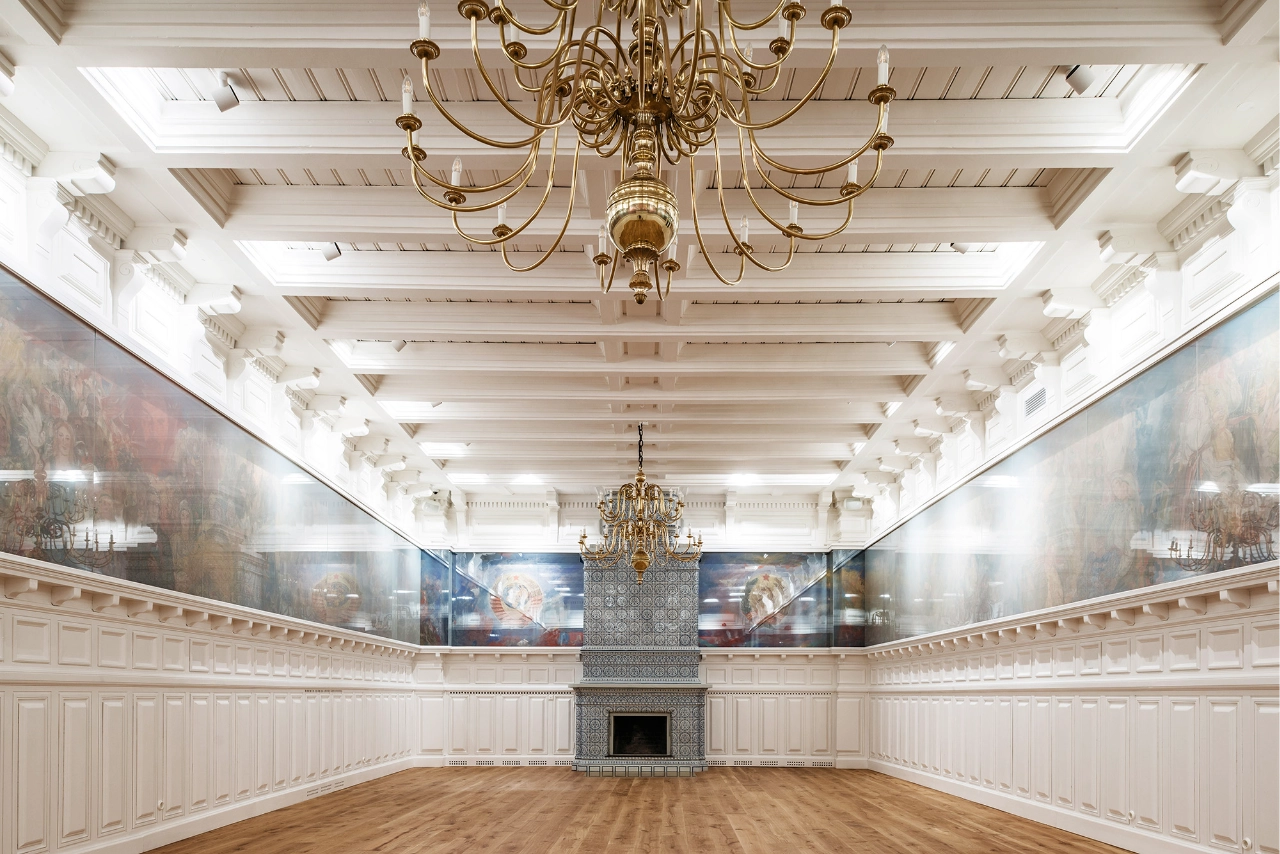
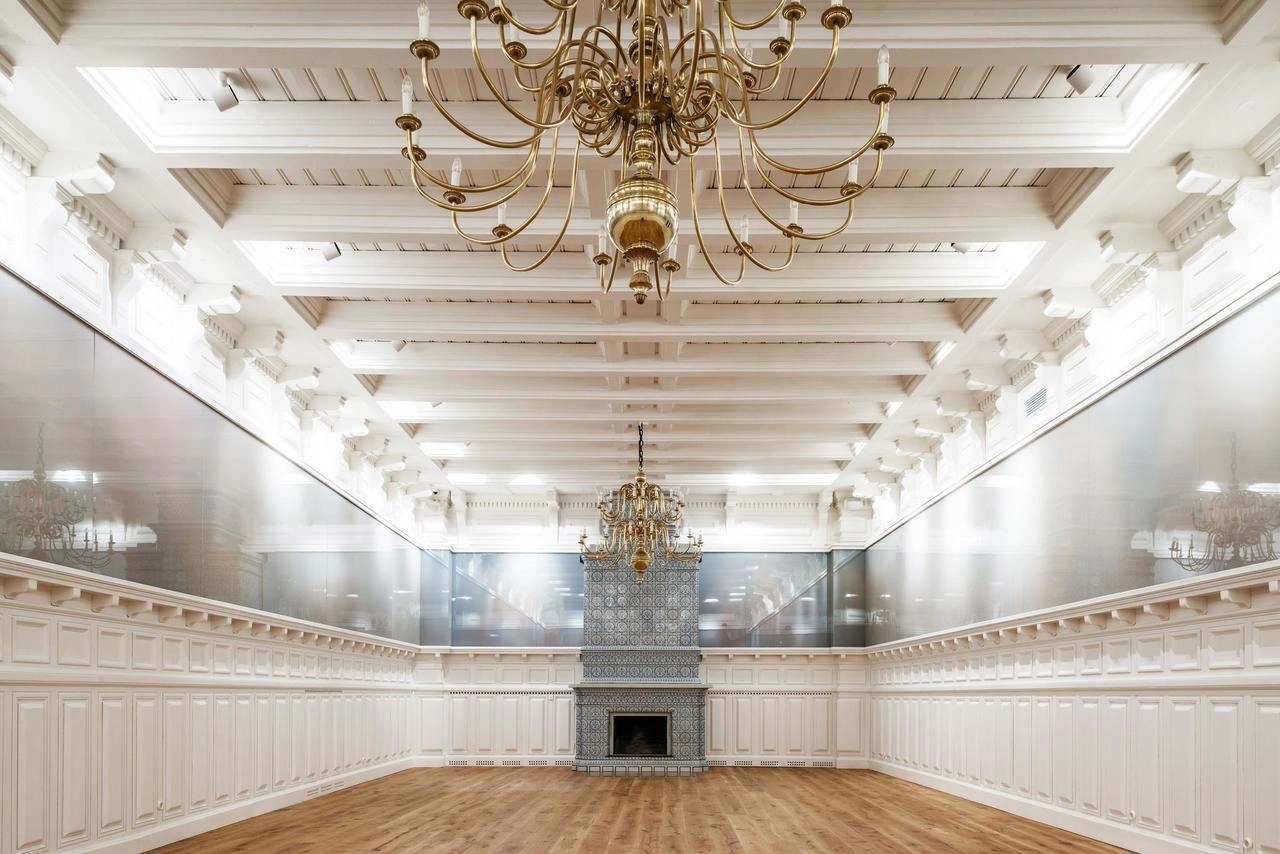
In 2018, on the 100th anniversary of the Republic of Estonia, the Estonian History Museum’s Maarjamäe Palace was opened as a “discovery center”–offering a venue for receptions, concerts, and seminars. Its summer hall room is advertised as featuring Evald Okas’ Soviet monumental painting The Friendship of Nations. This visual legacy that Estonian museum inherited from its Soviet past carries an entangled set of ideological, ethical, aesthetical, and historical messages. They can be manually activated by a single switch that controls a covering interactive glass that becomes opaque or fully transparent. “[I]f necessary, the painting can be covered,” the description states.
Focusing on the material culture produced in the Soviet period in Estonia, Latvia, and Lithuania, such as paintings (murals, frescoes, mosaics), architectural objects, urban spaces, monuments, spaces and aesthetic/anesthetic regimes they are situated in, this postdoctoral project analyzes and speculates upon the strong affective weight of the Soviet era artifacts in the Baltic states as signifiers of colonial oppression. The project, entitled “Soviets Objects in the Post-Soviet Spaces in the Baltic Countries,” will remediate insights developed in my doctoral research about the entanglements between the last Soviet generation of non-fiction filmmakers and the representations and negotiations of issues of national identity they had to face.
It placed issues of postcolonial legacies and post-Soviet identity in the contemporary Baltic States in the context of continuing public debates on historical identification of the nations within the shifting borders and geographies, political traditions, and historical geneses. The study will focus on the relocation of the post-Soviet objects (such “heterotopic spaces,” to use Michel Foucault’s term, as Grūtas Park near Vilnius or Estonia History Museum’s backyard, both housing exhibitions of discarded monuments of the Soviet leaders). Drawing on and debating with conversations in the history of communist countries (Skrodzka et all 2020), environmental studies (Annus 2020), postcolonial studies and postsocialisms in Eastern Europe (Tlostanova 2018; Moore 2001; Annus 2018), memory studies (Guerin and Hallas 2007) and material studies (Latour 1993; Oushakine 2020) this research will examine the functions of the Soviet material remains in the Baltics.
Once functioning as organic elements of the local environments, they lost their consistent utility and acquired the new ontological status as unstable objects in need of reconstruction, repurpose, displacement, and masking. Post-communist cultures and spaces have come under scrutiny in terms of migration and (re-)conceptualization of the residues left by the vanished Soviet authority. Anthropologist of migration Dace Dzenovska describes this social formation through an ethnographic concept of “emptiness”. In these terms, “The future as the end of the world emerges in conditions when the horizon of expectations of socialist modernity is gone and the promises of capitalist modernity have failed.” (2019) . Therefore, Dzenovska looks at the post-Soviet spaces through an analysis of the postcommunist attempts to establish European modernity not only in relation to the socialist past but also the global present. For Dzenovska, the modern Latvian subject experiences a paradigm change: if in the XX century migration was part of the modernization and proceeded in correspondence to the dominant ideology–deserted places had to be reincorporated into the models of modernization and progress–after the collapse of the Soviet Union people and places are expelled from circuits of capital and care of the state.
Relatedly, these places turn into ruins, which accumulation leads to historical disintegration, departure, and displacement of the past by the logic of the present (Simmel 1995, Benjamin 2020). Consequently, it leads to an aestheticization of emptiness and ruins by the foreign, “already-modernized” “western” subject who perceives the Soviet remains not as a repository of collective trauma but an aboriginal object of the indigenous culture, necessitating new methodologies of cultural analysis (Arkhipova and Kirzyuk 2019; Lebina 2019; Ivanova 2018). On the one hand, this reflects an anthropological turn in historiography, associated with a move away from institutional political and structuralist social history towards a growing focus on the experiences of ordinary people, particularly within oral history. On the other, it connects to the emerging “historical turn” in anthropology, where the notion of archives has been increasingly central. My project reflects such “convergence” of history and anthropology, while situating it in relation to media studies’ recent turn towards material culture.
My project will look at the (post-)Soviet periphery and help to see many shades of the “Soviet” beyond the black and white picture of Soviet history commonly written from a Russo-centric perspective. While Baltic postcolonial culture and history become more and more represented across scholarly literature (see Burima 2018; Annus 2018; Davoliūtė 2014; Kalertas 2006), the only Soviet-built visual objects that have been awarded closer attention have been in the fields of architecture and urban planning (Hess and Tammaru 2019; Martinez 2018; Ingerpuu 2019). My research expands this approach to address the plurality of social life, the multiple and multilayered forms of engagement with the world. In my project, I will reframe cultural objects of the Soviet-era living in the present-day Baltics as knots of relationships, connections, associations, with which everyone deals personally, experiencing individual and qualitative experiences.
In the case of Okas’ fresco, the painting can be described as a heterogeneous entanglement of human, material, corporeal and command with its material resistance and cumulative effect (covering glass, theme, scale, viewer’s body, a choice to turn it on or off). This entanglement can be described as a mediation that is equally resistant to sociological reductionism and assumptions of autonomy of the object (Hennion 2016). In other words, Soviet objects (buildings, design, urban environment) are not the remains of a former civilization but the things that form the present one. Since three Baltic republics have joined the EU and integrated their economies into a transnational area, the remaining Soviet materiality started changing its status as being visible and consumed by international companies and tourists.
Highly popular antique and thrift stores advertise different Soviet-era artifacts as a hard-to-find and thus most desired vintage. “Soviet Riga/Vilnius/Tallinn walking tours” which include visiting KGB museums and abandoned Soviet administrative buildings need to be booked far in advance during high season due to excessive demand. Some places which carried highly negative affective weight in the 1990s found new life as cultural heritage (such as the remains of a mural at the Soviet naval base in Naissaare Island). The region is frequently used for location shootings standing in for abstract “(post)Soviet” countries (to name a few: “Tennet”, 2020; “Chernobyl,” 2019; “Stranger Things,” 2022). My project attends to these new contexts and remediations through which the remnants of Soviet past find their present lives.
Research Questions
My research will pose three primary research questions:
What are the strategies and practices of masking, restructuring, and assimilation of the Soviet era objects in the Baltic states, and how do communities relate to these images as tools of memory within complex postcolonial histories?
Where do the things as objects of sociological suspicion and alienation of their material regime and agencies actualise?
How do they perform in an idiosyncratic relationship of bodies and apparatuses? How does the change of research optics from structural approach to the paradigm of network in a study of the post-Soviet everydayness alternate our perception of the Soviet things as active and autarchic objects?
With these as leading questions, I will also address ongoing practices of resistance from concealing and masking to more radical methods such as complete reconstruction and relocation.
Theoretical Approach
The material presence of the Soviet past embedded with ideologies in the Baltics is incredibly tangible and accessible in great quantities. While it still causes ongoing public debates about its existence in the process of constructing new identities on different levels (national, regional, or global), this vanishing materiality helps us to understand the cultural, historical, and political stakes of the environment that govern the circulation of quotidian life (Boym 2017). With prominent exceptions in studies of post-Soviet nostalgia (see Kalinina 2014; Boele et al. 2020; Boym 1995), media studies as a discipline has often conceptually overlooked and methodologically migrated from studying the things themselves.
My use of a broadly transdisciplinary set of literatures and methodologies will help rehabilitate the status of political and quotidian Soviet-era visual culture in contemporary post-Soviet studies, taking cues from postcolonial theory and decolonial modernity theorization, anthropology, and cultural studies, along with my disciplinary expertise in media studies and late-Soviet Baltic art history. While the Baltic countries’ status as former colonies of the USSR is complicated due to conceptual (Moore 2001) and historical factors (ongoing debates on colonization vs occupation), it is nonetheless worth further (re)articulating our understanding of these (post)colonial legacies as complex and multifactorial processes that historically caused an appearance of a synthesized local Soviet productive and creative subject.
While this subject has been expelled from the governance after three Baltic nations regained their independence, the objects produced before the collapse of the Soviet state, started acting on their own, avoiding authorial management, resisting and adapting to the changing context. In order to look at the Soviet material artifacts as active parts of living experiences, I will re-theorize them as being segments of processes of everydayness. The study of quotidian life in the history of intellectual culture is preserved in a vast body of philosophical and scientific literature of the twentieth century. And yet, the traditional approaches towards these histories require revision and refinement in a transformed and changing world that is no longer reducible to a preordained and predictable experiences.
Thinking about the material Soviet legacy through a composition of social world, I will theorize and expand construction of the complex networks of the Soviet objects as meshwork (Citton 2016) to reconstruct the environment in which the things are immersed, to describe the forces and currents through which the impact spreads in the media(um) field. Building on existing studies of media agency, orientalism, and post-Soviet migration (Citton 2016; Annus 2020; Dzenovska 2020), I will articulate the relation between the Soviet produced material culture and modern post(colonial) Baltic locus through versatile regimes of presence and visibility, focusing especially on public spaces and their remediations.
Objectives
Using the several types of the Soviet material legacy (ruined, restored, reconstructed, concealed) and building off of the theoretical literature mentioned above, my research will work to achieve three objectives.
To work with local residents who live in environments inhabited by the Soviet visual objects, people who interact with the remnants due to professional reasons (custodians, artists, public service personnel, volunteers) to better understand the relations between the historical sites and the (anti)post-Soviet dynamics in the Baltic society.
To map the place of the Baltic countries within the uneven post-communist spaces of Eastern Europe and relate it to larger and contradictory histories of colonialism in the Baltic region.
To contribute to wider conversation about the historical and spatial imagination and migration of imagery in Baltic postcolonial societies after the collapse of the USSR.
Methodology
My research is based on intensive fieldwork I performed in the cultural institutions across the three Baltic republics. I will be analyzing interviews, photo and video materials, urban plans and policies I collected during my trip to the region. In the Summer and Fall of 2019, I spent four months doing doctoral field work in the Baltics on a research travel grant I received from Concordia University. While in the Baltics, I visited and collaborated with scholars, archivists, cultural managers, and artists from Riga and Jūrmala (Latvia), Vilnius, Kaunas, and Grūta (Lithuania), Tallinn and Pärnu (Estonia). I was immersed in anthropogeography and debates around the post-Soviet material heritage in the Baltics. I was exposed to a variety of anthropological and artistic approaches to the spacial development of the public spaces habituated by the remnants of the past which media studies have often struggled to articulate.
Learning from different historical contexts and interpretative models, my research methodologies focus on tracing the duality of Soviet objects in the post-Soviet Baltic spaces. My conscious choice to address the anthropological methods in studying non-human objects informs my methodology by foregrounding the material cultures around the clash between memory and history of the Soviet occupation of the region and the social environments within which the confrontation emerges. The socio-cultural life of the remains of the Soviet period can only be studied by drawing from a wide range of interdisciplinary approaches and learning from community members surrounded by the Soviet residues that continue to be the fragments of their lives.
In general, the methodology of the project responds to the specifics of the subject. This provides a possibility to refer to various research methodological techniques and methods that are most efficient in studying the subject within the structure of the project. Thus, the methodology is a synthesis of different theoretical approaches to the study of the issues concerning regional (re)integration in the western borderlands of the post-Soviet spaces. The methodological basis of the project is a systematic analysis of sociocultural phenomena, which allows considering the chosen object of research as a holistic multifunctional and polymorphic phenomenon resulting from a variety of cultural, historical, and social factors. In this aspect, the chosen methodology verges upon the subject area of social anthropology in its contemporary contours as a study of the entire diversity of socio-cultural phenomena including interactions of individuals, institutions, social communities, and cultures. At certain stages of the project, I will apply socio-cultural, phenomenological, structural, functional, and formational approaches to the analysis of the post-Soviet objects in the Baltic states and the post-Soviet identities they affect. I will apply these approaches to the analysis of press releases, policy and planning documents, tourist materials, and cinematic representations to put in comparison to data gathered from the field. By studying the Soviet physical presence in the Baltic city landscapes, along with the social worlds and everyday narratives around it, I will reveal the mechanisms of formation and dynamic of post-Sovietness that operates within complex and layered material histories that continue to write themselves in the present day.